The Great Decoupling
What Google’s 2026 Announcement Signals for Lead Generation
By Dipak Kamdar, Partner at SAVD
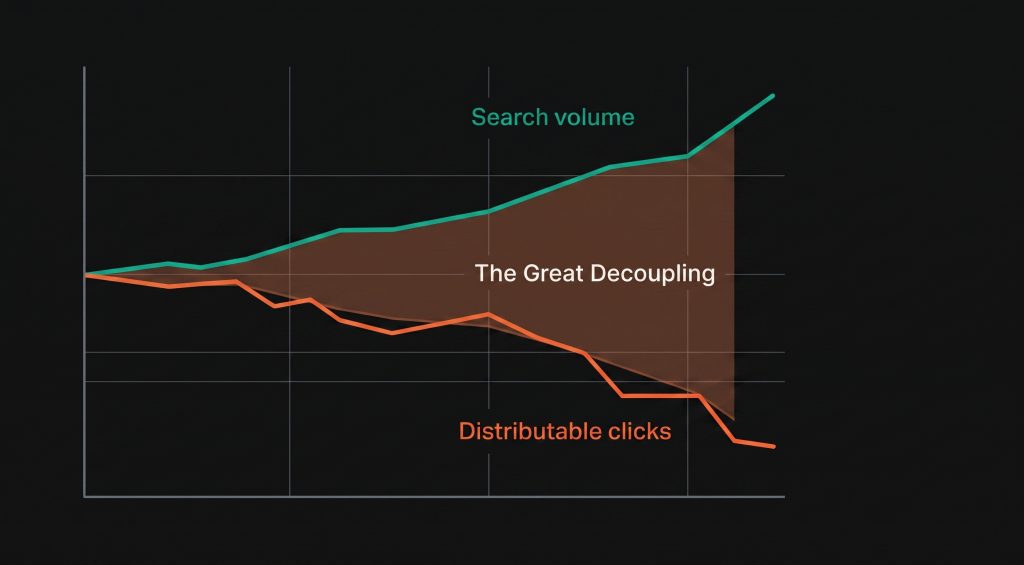
The Great Decoupling is the separation of search volume from distributable clicks: queries keep growing while the share that leaves the platform keeps shrinking. For businesses built on traffic arbitrage, it turns a marketing problem into a business model problem, because the comparison layer they monetize is being absorbed.
I’ve been reflecting on Google’s February 11th announcement. Not on the feature set, but on the direction.
What stands out is compression.
Over the past five years, Google has progressively absorbed layers of the advertising and commerce stack: bidding, creative, optimization, measurement, and checkout. The latest shift extends into comparison and transaction routing. For lead generation businesses, comparison is the economic layer. That is where the structural pressure now sits.
- What Is the Great Decoupling?
- A Five-Year Pattern of Vertical Integration
- The Dual Compression Facing Lead Aggregators
- The Competitive Environment Is Broader Than Search
- What Becomes Structurally Defensible
- Vertical Implications
- The Valuation Implication
- The Diagnostic: Five Signals of Structural Exposure
- Strategic Implication
What Is the Great Decoupling?
The Great Decoupling is the separation of search volume from distributable clicks: queries keep growing while the share that leaves the platform keeps shrinking. For businesses built on traffic arbitrage, it turns a marketing problem into a business model problem, because the comparison layer they monetize is being absorbed.
A Five-Year Pattern of Vertical Integration
This development did not begin in 2026.
In 2021-22, Performance Max reduced advertiser control and consolidated inventory under automated systems. In 2023-24, AI Overviews began satisfying informational intent directly within search results, and traffic to third-party sites started bleeding. By 2025, AI-driven bidding and closed-loop infrastructure had matured through AI Max and the Agent Payments Protocol (AP2). Now in 2026, the Universal Commerce Protocol (UCP) introduces structured, machine-readable offers and in-platform transaction capability.
Each phase incrementally reduced reliance on outbound clicks and external comparison surfaces. Search volume remains strong, but click dependency is weakening. For platforms, this is efficiency expansion. For intermediaries, it reduces surface area.
What Vidhya Srinivasan called an “expansionary moment” is expansionary for Google. For companies that sit between the search query and the transaction, it is the opposite.
The Dual Compression Facing Lead Aggregators
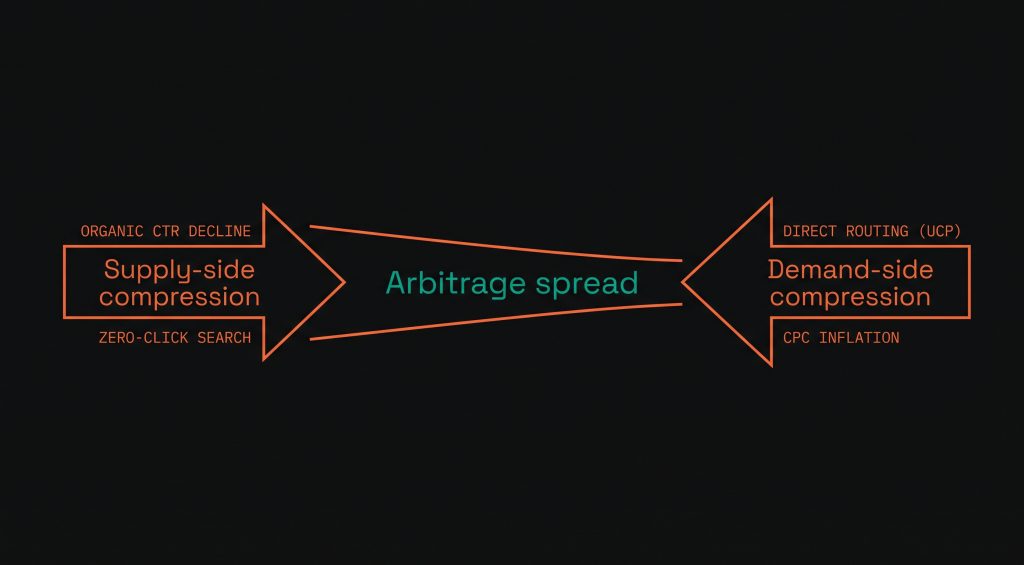
Lead generation models are encountering pressure from both sides simultaneously.
Supply-Side Compression
Seer Interactive measured a 61% decline in organic CTR on queries with AI Overviews, across 3,119 queries and 25.1 million impressions over 15 months. Bain reported that 60% of searches now end without a click, rising to 77% on mobile. Media leaders project sustained search referral decline over the next several years.
The raw demand still exists. The path it takes to reach an intermediary is narrowing.
Demand-Side Compression
At the same time, buyers are gaining direct routing options through structured integrations like UCP. Cost-per-click inflation continues in high-LTV verticals, with the most competitive insurance terms exceeding $900 per click. Performance transparency is increasing scrutiny on lead quality and incrementality. And platform-native formats are reducing reliance on third-party intermediaries altogether.
The traditional arbitrage spread (traffic acquisition cost versus lead monetization) is narrowing from both ends. This is structural, not cyclical.
The Competitive Environment Is Broader Than Search
This is not a Google-only dynamic.
ChatGPT introduced ads and conversational commerce with 900 million weekly users (OpenAI, February 2026) and instant checkout already live through Shopify. Social platforms increasingly compress discovery and transaction into single environments. TikTok Shop alone is projected to pass $20 billion in US gross merchandise value in 2026 (eMarketer). Retail media networks capture transactional product search. Streaming platforms absorb upper-funnel brand budgets, with Netflix guiding to roughly $3 billion in 2026 ad revenue.
Across each of these environments, the pattern is the same: closed-loop ecosystems are expanding, and the intermediary comparison layer becomes less central unless it controls something the ecosystem cannot provide on its own.
What Becomes Structurally Defensible
The most exposed positions are generic comparison content, SEO-dependent traffic models, shared lead routing without differentiation, and static rate or offer aggregation. These are the assets AI replicates most easily and platforms absorb most quickly.
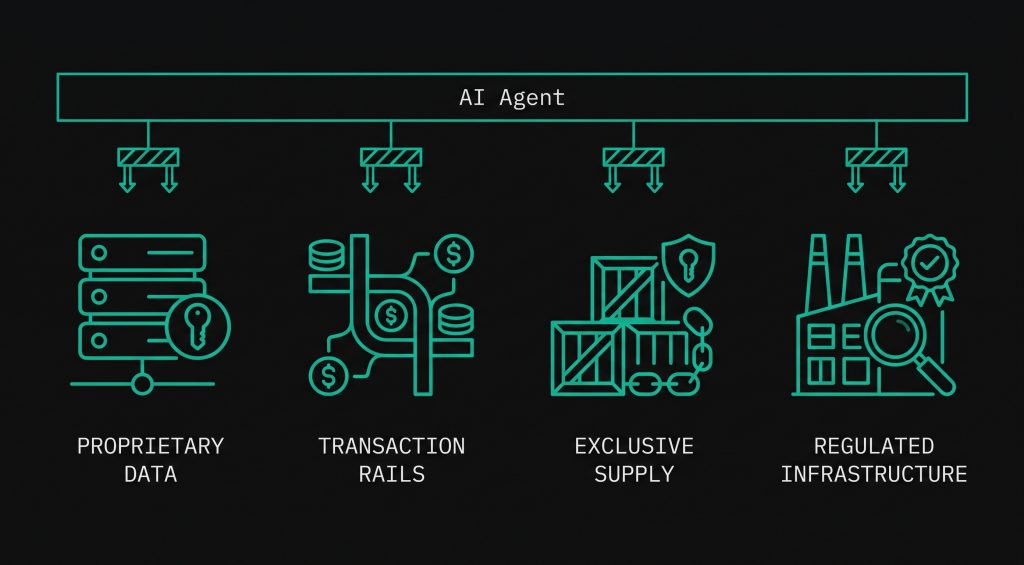
The more durable positions share a common characteristic: they involve something an AI agent needs but cannot independently generate.
Proprietary data. Claims history, outcome data, real-time pricing, authenticated credit profiles. This information is non-public, dynamic, and fenced behind permissions. An LLM cannot scrape what it cannot access.
Transaction rails. Embedded checkout, pre-qualification engines, UCP integration, billing and settlement infrastructure. AI agents need rails to ride on.
Exclusive supply. Legal exclusivity contracts with carriers or providers that block direct-to-AI access. If an agent cannot reach a provider without going through your exchange, you remain in the path.
Regulated infrastructure. TCPA compliance, CMS enrollment rules, state licensing requirements, physical verification of service providers. AI cannot independently assume regulatory liability or verify that a roofer is insured and local.
The shift is from content advantage to infrastructure advantage.
Vertical Implications
The pattern is consistent across high-CPC verticals. In insurance, the defensible position moves from generic listicles toward real-time API pricing exchanges and compliance infrastructure, with revenue shifting toward agency commissions and completed policy sales. In banking and finance, it moves from static rate tables toward authenticated identity and embedded pre-qualification, with revenue shifting toward success fees on funded outcomes. In home services and legal, it moves from shared leads toward operational control (scheduling, dispatch, verified reviews) with revenue tied to booked appointments or job value. In telco and energy, it moves from generic availability lists toward address-level data accuracy and billing complexity, with revenue shifting toward lifecycle management.
In each case, the underlying question is the same: are you selling a click, or are you controlling the outcome?
The Valuation Implication
Public and private markets increasingly distinguish between traffic-dependent media models, infrastructure or exchange platforms, vertical SaaS operators, and licensed or renewal-driven businesses. The multiples reflect the distinction clearly.
Businesses that control proprietary data, transaction rails, or recurring relationships command structurally higher valuations than those dependent on organic arbitrage. A media model built on SEO trades at a fraction of what a vertical platform with first-party data and recurring revenue commands.
The strategic question is whether the business can evolve beyond traffic dependency entirely.
The Diagnostic: Five Signals of Structural Exposure
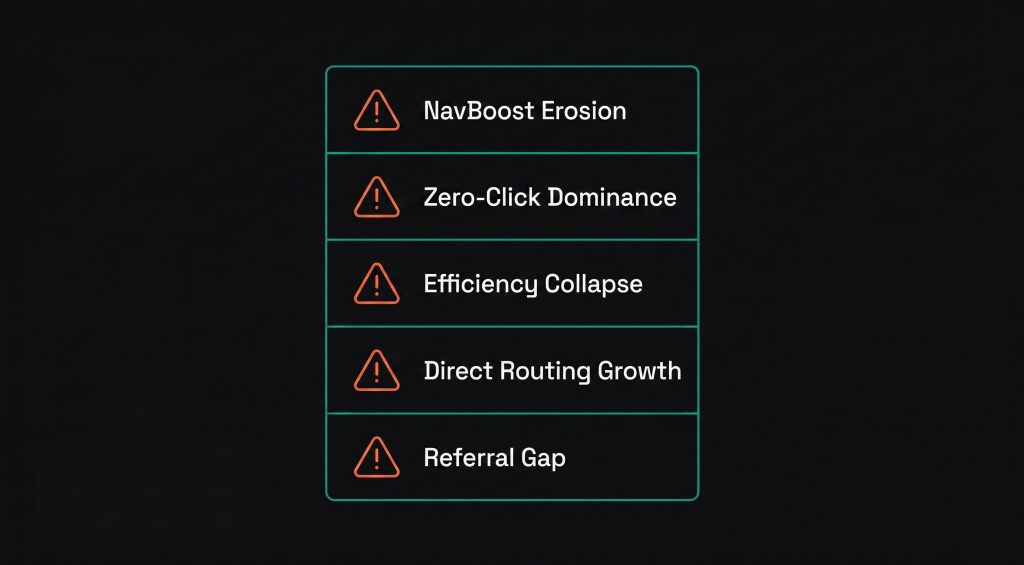
For operators and investors evaluating exposure, five signals indicate the arbitrage model is already under pressure:
- NavBoost erosion: navigational queries in your category are increasingly satisfied on-page, and users skip the intermediary site.
- Zero-click dominance: mobile zero-click rates above 80% in your core query categories.
- Efficiency collapse: LTV-to-CAC ratio dropping below 3.0 as acquisition costs rise faster than monetization.
- Direct routing growth: increasing “direct-to-provider” click share in AI Mode results, bypassing comparison surfaces.
- Referral gap: LLM referral traffic replacing less than 5% of lost search volume, meaning new discovery channels are not compensating for search decline.
If three or more of these apply, the transition window is shorter than it appears.
Strategic Implication
This is a call to redefine what kind of business a lead generation company actually is.
Traffic arbitrage is being compressed. Infrastructure ownership is being repriced upward. The transition window is open, but it will not remain open indefinitely.
The question for operators and investors is whether the business model evolves before dependency becomes irreversible.
Repositioning requires architectural decisions, not marketing optimizations: converting traffic into authenticated identity, building machine-readable offer infrastructure, owning eligibility and qualification logic, shifting monetization toward outcomes, and increasing control over the transaction moment.
Frequently Asked Questions
What is the Great Decoupling?
The Great Decoupling is the separation of search volume from distributable clicks: queries keep growing while the share that leaves the platform keeps shrinking. For businesses built on traffic arbitrage, it turns a marketing problem into a business model problem, because the comparison layer they monetize is being absorbed.
What makes a lead generation business structurally defensible against AI agents?
Proprietary data, transaction rails, exclusive supply, and regulated infrastructure are the assets an AI agent needs but cannot independently generate. Businesses built on generic comparison content, SEO-dependent traffic, or shared lead routing are the most exposed, since AI replicates and platforms absorb those assets most easily.
What are the five signals that a lead generation business is structurally exposed?
NavBoost erosion, mobile zero-click rates above 80%, an LTV-to-CAC ratio below 3.0, growing direct-to-provider routing in AI Mode results, and LLM referral traffic replacing less than 5% of lost search volume. If three or more apply, the transition window is shorter than it appears.
How does this compression affect business valuation?
Businesses that control proprietary data, transaction rails, or recurring relationships command structurally higher valuations than those dependent on organic arbitrage. A media model built on SEO trades at a fraction of what a vertical platform with first-party data and recurring revenue commands.
What does repositioning against this compression actually require?
Repositioning requires architectural decisions, not marketing optimizations: converting traffic into authenticated identity, building machine-readable offer infrastructure, owning eligibility and qualification logic, shifting monetization toward outcomes, and increasing control over the transaction moment.
About SAVD
SAVD BY AI is a system-level consultancy for AI-driven marketing organizations. We work with enterprise operators and institutional investors to diagnose structural exposure across high-CPC acquisition models and build the measurement and decision systems that outlast traffic dependency. Our focus is business model durability, not traffic recovery.
We are developing an agentic enablement layer designed to strengthen lead generation funnels through earlier eligibility resolution, structured offer integration, and clearer downstream performance visibility.
For operators and investors evaluating structural exposure, we welcome the conversation.
This analysis draws on Google’s 2026 Ads & Commerce letter, Seer Interactive CTR research, Bain zero-click data, and market observations across insurance, financial services, home services, and telco verticals.
Related Reading
how attribution starves brand budgets in the Doom Loop
the cost, customers, and customer value framework
how routing intelligence coordinates customer decisions
scoring angels and devils in customer evaluation
Stay connected: follow SAVD on LinkedIn for ongoing analysis of structural shifts in performance marketing and lead generation.
Dipak Kamdar is a Partner at SAVD BY AI, a system-level consultancy for AI-driven marketing organizations. SAVD pairs product leads who worked on some of Google’s largest lead-generation advertisers, working closely with the engineers behind its Bidding, AI Max, and Performance Max systems, with PhD data scientists with deep marketing-science expertise.