SAVD by “Routing Intelligence” – The Missing Layer in High-Velocity Growth Stacks
Part of the “SAVD by” Series
By Dipak Kamdar, Partner at SAVD
Routing intelligence is the operating layer that determines how customer interactions get prioritized, sequenced, and monetized across the enterprise. It evaluates each user’s historical and real-time state and selects the next action that maximizes one global financial outcome, rather than optimizing a single local channel metric.
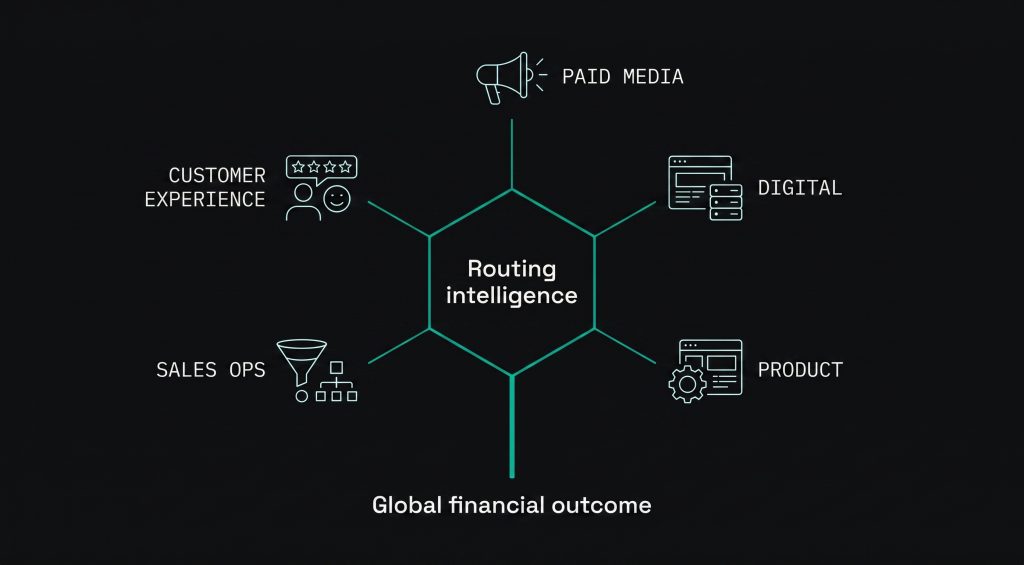
In our opening chapters we analyzed the collapse of traditional customer acquisition in the Doom Loop that starves brand budgets and mapped the execution frameworks required to build a New Age of Growth Marketing. Both established that high-velocity growth has broken past the limits of isolated marketing teams.
In Q1 2026, EverQuote reported a Variable Marketing Margin (revenue kept after advertising spend) of 29.3%, up both sequentially and year over year, proving this thesis. They expanded efficiency even as the broader open web faced a structural cliff in organic click-through rates.
The companies winning right now are better at coordinating downstream decisions than at optimizing any single channel.
The industry spent the last decade chasing data unification while handing execution over to black-box platform algorithms. Unifying data is not the same as unifying decisions.
- The Functional Silo Pathology
- The Structural Disconnect in Modern Growth Architectures
- 1. Optimization Systems Train Against Dead Environments
- 2. Signal Gaps Are Actually Governance Gaps (and Underutilized GenAI Surfaces)
- 3. Measurement Infrastructure Confuses Efficiency with Profitability
- Phase 1: Immediate Actions (Days 1-90): Establish Decision Coherence
- Phase 2: Short-Term Actions (Months 3-6): Build the Routing Foundation
- Phase 3: Long-Term Actions (Months 6-12): Build the Coordination Moat
The Functional Silo Pathology
Most growth organizations still operate as a collection of disconnected, functional silos:
- Paid Media optimizes for the lowest acquisition cost
- Digital teams optimize landing pages for localized conversion rates
- Product optimizes onboarding flows for immediate feature activation
- Sales Operations optimizes queues for raw speed-to-lead velocity
- Customer Experience optimizes chat routing for minimal resolution time.
Each function is locally rational, and the enterprise still loses margin.
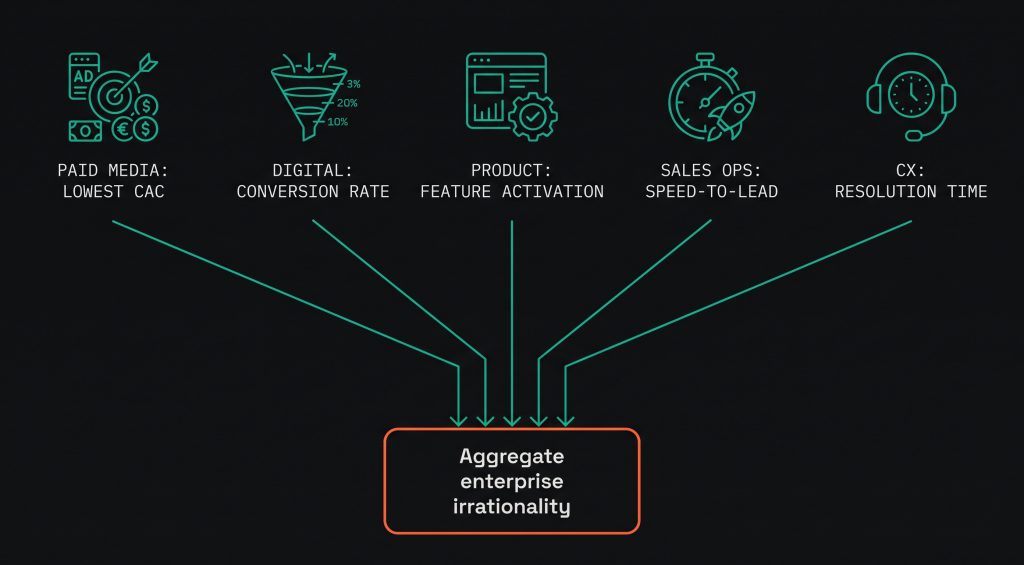
Routing intelligence is the missing decision layer that coordinates the various customer interactions towards a single, global economic outcome. As AI compresses search discovery, abstracts channel bidding, and mediates transactions, this central coordination layer becomes an enterprise’s primary source of competitive advantage.
The Three-Front Compression: Why Local Optimization Destroys Global Margin
When growth functions operate as an isolated optimization system, downstream economics systematically erode. A performance campaign generates a high volume of inexpensive leads, creating the illusion of front-end growth. Over time, the true financial performance stalls: sales cycles lengthen, close rates weaken, user retention falls, customer support costs balloon, and net contribution margins compress.
Everyone hits their functional KPI, but nobody owns the ultimate business outcome.
Organizations survived this structural fragmentation because organic distribution remained abundant and highly measurable. That environment no longer exists. Companies that continue to optimize channels independently are simply running faster loops against broken policies.
Over the last eighteen months, the traditional growth stack lost visibility and direct control in three places simultaneously.
- Discovery: AI-generated search experiences capture user intent directly on the results page, drying up organic click volume before users ever reach a brand’s domain. The customer who once compared ten distinct links now consumes a single, machine-synthesized answer.
- Optimization: Performance media platforms operate as entirely automated black boxes. The controllable surface area inside Google, Meta, and Amazon shrinks every quarter. Because AI has commoditized front-end execution, internal coordination is the only remaining moat.
- Transactions: Autonomous AI agents are beginning to evaluate marketplace offers, compare product features, and complete transactions on behalf of users.
Fewer clicks, less transparency, and less control remain.
The organizations that route customer intent intelligently will outperform the organizations that optimize channels independently.
What Is Routing Intelligence?
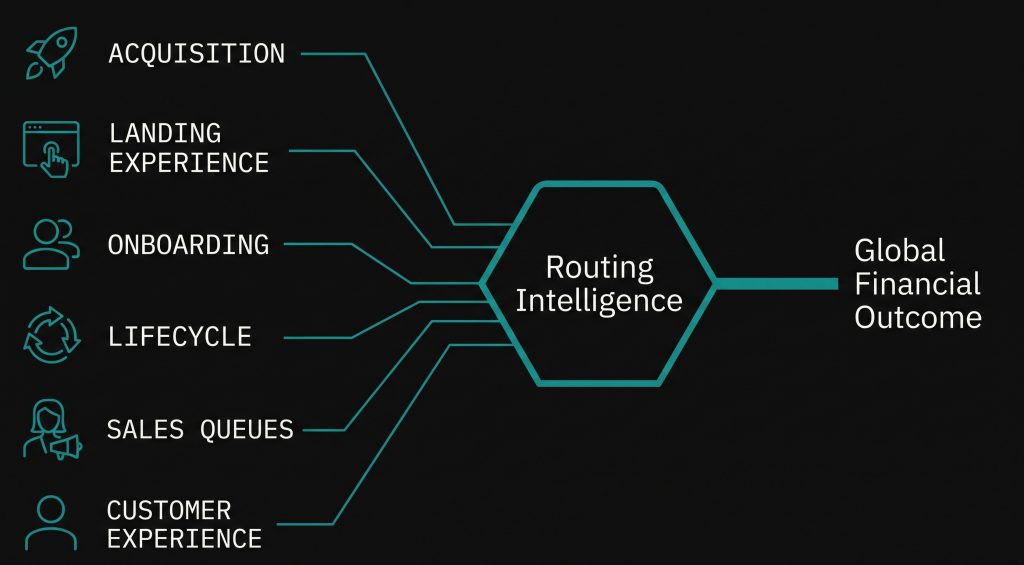
Routing intelligence is the operating layer that determines how customer interactions get prioritized, sequenced, and monetized across the enterprise. It evaluates the historical and real-time state of each user and selects the next action that maximizes one global financial outcome instead of a local channel metric. At its core, it continuously evaluates a single operational question:
Given everything known about this user, historical and real-time, what next best action maximizes our global business outcome?
This shifts the organization away from functional handoffs. It treats acquisition, landing experiences, onboarding, lifecycle, sales queues, and customer experience as a single, synchronized decision engine operating against a shared financial objective.
To deploy this layer, operators must clearly separate it from legacy software definitions:
- It is not lead routing. Static tools like LeanData or Chili Piper route a record to a sales rep after a form conversion occurs. Routing intelligence determines whether that user should enter a sales queue at all, or be routed to a self-serve product flow, a lifecycle nurture track, or a distinct retargeting campaign.
- It is not attribution modeling. Attribution models, dashboards, and platform reports remain strictly backward-looking. They excel at explaining “what happened” by allocating past credit. Routing intelligence is a forward-looking action engine that determines what should happen next. This distinction becomes critical as platform opacity and signal loss make backward-looking tracking less reliable.
- It is not a Customer Data Platform (CDP). A CDP aggregates and unifies identity data into static repositories. Routing intelligence operationalizes that data by executing real-time decisions against it.
The Structural Disconnect in Modern Growth Architectures
The modern enterprise has spent millions unifying customer data; almost none have unified customer decision-making. Based on the operating architectures we analyze, the core barrier to scale is rarely a lack of tooling. It is the presence of fragmented decision loops that cause legacy systems to break in two predictable places:
1. Optimization Systems Train Against Dead Environments
Most acquisition engines rely heavily on historical conversion feedback loops. However, because internal functions change independently, the downstream routing environment is in constant flux: product teams modify onboarding steps, sales alters queue priorities, and lifecycle teams adjust email triggers. Because no single leader owns routing intelligence across the entire user journey, front-end optimization loops train against yesterday’s routing logic while the business operates under a new one.
2. Signal Gaps Are Actually Governance Gaps (and Underutilized GenAI Surfaces)
The enterprise rarely suffers from a lack of raw signal volume. Organizations already capture data from sales interactions, onboarding friction points, in-app product behavior, support logs, and lifecycle drop-offs. The failure occurs because these multi-channel signals are never standardized, weighted, and aggregated into a single, persistent customer state score.
This is where most organizations underutilize Generative AI. The market views GenAI primarily as a content creation layer to spin up copy or creative variants faster. Its true enterprise value lies in serving as a signal translation layer. Organizations sit on massive volumes of unstructured conversational and behavioral data that never become usable routing inputs. GenAI can parse, structure, and operationalize these qualitative interactions in real time. The strategic opportunity is a deeper customer understanding that improves predicted lifetime value models, routing precision, and downstream economics.
3. Measurement Infrastructure Confuses Efficiency with Profitability
Many organizations optimize against platform-reported outcomes without independently measuring whether those outcomes create true incremental business value. Without exogenous incrementality infrastructure, growth teams frequently mistake attribution for causality, channel efficiency for corporate profitability, and raw conversion volume for net enterprise value. They run highly optimized campaigns that harvest existing brand equity rather than generating marginal revenue.
The New Enterprise Constraint
Growth organizations used to compete on execution variables: media buying precision, hyper-granular targeting parameters, creative volume, and channel-specific hacks.
Those capabilities still matter, but AI-enabled ad tooling is standardizing and commoditizing front-end channel execution faster than most operators realize.
When optimization becomes a commodity, coordination becomes the only scarce asset.
The companies creating structural advantage are building systems where every customer-facing function operates against the same definition of value. Dataset size, budget, and model sophistication matter less.
This requires four synchronized assets:
- Unified Financial Objective: One financial hurdle rate verified by the CFO.
- Persistent Customer State: A single, persistent score consumed by all software.
- Automated Policy Layer: An automated decision engine directing the next-best-action.
- Cross-Functional Governance Cadence: A cross-functional routing council led by operations.
That is precisely what routing intelligence creates.
The SAVD Way: From Channel Optimization to Enterprise Coordination
The next era of growth will be defined by who coordinates customer decisions most intelligently. AI is accelerating this shift.
As search discovery becomes intermediated, platform optimization becomes automated, and transactions become increasingly agentic, organizations with integrated routing systems will compound structurally faster than those operating with disconnected functions.
The advantage comes from running a more coordinated business.
The path from marketing dollars to sustainable business growth has become fragmented, opaque, and indirect. Routing intelligence is the structural layer that makes it coherent again. This is the core thesis of The SAVD Way. We look past superficial channel metrics to build growth engines anchored directly to enterprise economics.
The Operational Blueprint: What to Do Now
Transitioning to this model requires a staged approach. The first priority is organizational alignment.
Phase 1: Immediate Actions (Days 1-90): Establish Decision Coherence
Before deploying complex infrastructure, operators must identify and eliminate the fragmented optimization loops that damage margin. In practice, these friction points surface quickly: acquisition incentives conflict with sales capacity, onboarding flows conflict with monetization gates, and platform-reported efficiency conflicts with actual contribution margin.
To break this cycle, organizations must take three immediate actions:
- Establish a Single Enterprise Outcome Metric: Partner with the CEO and CFO to codify one definitive financial hurdle rate (such as contribution margin per acquired user or LTV/CAC payback velocity) that every department is measured against.
- Audit Routing Fragmentation: Map the complete customer journey to pinpoint exactly where user intent is handed off between siloed tools and disconnected teams.
- Build Shared Governance First: Stand up a weekly cross-functional Routing Council led by operations to resolve systemic metric conflicts before writing a single line of code.
Phase 2: Short-Term Actions (Months 3-6): Build the Routing Foundation
Once organizational alignment is established, the focus shifts to deploying the shared infrastructure required to make data actionable in real time. During this phase, teams discover that the real constraint is that the signals do not cohere.
- Deploy a Unified Customer-State Layer: Standardize your disparate data streams into a single, persistent propensity or pLTV score that paid media bids against, landing pages render against, and sales queues prioritize against.
- Instrument True Incrementality Infrastructure: Move away from pure platform attribution. Deploy exogenous testing frameworks (such as matched-market geo-experiments and randomized user holdouts) to isolate marginal lift.
- Operationalize Unstructured Signals via GenAI: Turn your repositories of unstructured conversational data (sales calls, support logs, chat transcripts) into structured inputs to refine your routing precision.
Phase 3: Long-Term Actions (Months 6-12): Build the Coordination Moat
Over time, routing intelligence evolves from a collection of isolated optimization rules into a compounding organizational asset.
In the long run, companies that compound value fastest build self-reinforcing loops where every customer interaction improves future routing precision, every corporate function operates against an identical definition of value, and every downstream outcome feeds directly back into the centralized model.
| Feature | Legacy Growth Stack | The SAVD Routing Moat |
|---|---|---|
| Primary Focus | Hyper-optimized local channel execution | Unified global decision coordination |
| Core Metric | CPL, platform ROAS, click volume | Contribution margin, LTV/CAC payback velocity |
| Data Utilization | Aggregated in static CDP repositories | Operationalized via real-time policy engines |
| Defensible Asset | Third-party platform algorithms | Proprietary customer-state data loop |
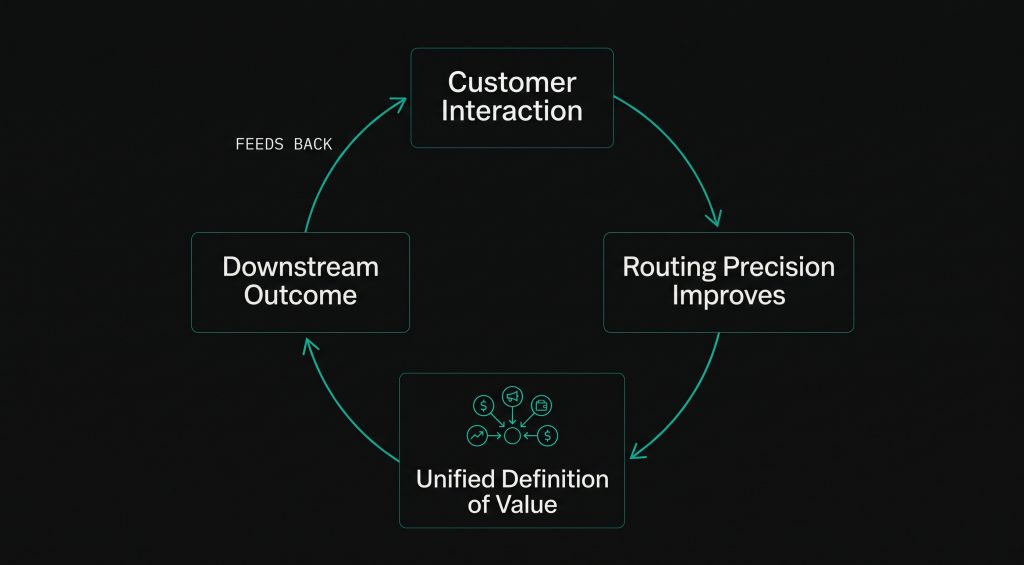
At this maturity level, your competitive advantage is no longer tied to commoditized variables like media buying or standalone ad copy. The advantage becomes coordinated decision-making itself.
This moat exists because your organization has earned a proprietary, operational understanding of how real-time customer states connect to long-term enterprise outcomes, not because the underlying models are impossible to replicate.
Frequently Asked Questions
What is routing intelligence?
Routing intelligence is the operating layer that determines how customer interactions get prioritized, sequenced, and monetized across the enterprise. It evaluates each user’s historical and real-time state and selects the next action that maximizes one global financial outcome, rather than optimizing a single local channel metric.
How is routing intelligence different from lead routing?
Static tools like LeanData or Chili Piper route a record to a sales rep after a form conversion happens. Routing intelligence decides whether that user should enter a sales queue at all, or move instead to a self-serve product flow, a lifecycle nurture track, or a separate retargeting campaign.
Is routing intelligence the same as attribution modeling?
Attribution models are backward-looking: they explain what happened by allocating past credit. Routing intelligence is forward-looking, determining what should happen next for each customer. That distinction matters more as platform opacity and signal loss make backward-looking tracking increasingly unreliable.
What four assets does routing intelligence require?
Routing intelligence requires four synchronized assets: a unified financial objective set with the CFO, a persistent customer-state score consumed by all software, an automated policy layer directing the next-best action, and a cross-functional governance cadence that keeps every function aligned to one definition of value.
Is routing intelligence the same as a Customer Data Platform (CDP)?
A Customer Data Platform aggregates and unifies identity data into a static repository. Routing intelligence goes further, operationalizing that same data by executing real-time decisions against it, turning stored identity data into the next action for each customer.
What are the first 90 days of building routing intelligence?
The first 90 days establish decision coherence. Codify one financial hurdle rate with the CEO and CFO, map where user intent gets handed off between siloed tools and disconnected teams, and stand up a weekly cross-functional Routing Council led by operations before writing a single line of code.
Partner With SAVD to Build Your Decision Layer
In modern performance marketing, data unification without decision unification is a stranded investment. Most corporate teams lack the cross-functional mandates and specialized causal data architecture required to bridge the gap between top-of-funnel media spend and contribution margins.
This is exactly why SAVD exists.
We partner with high-velocity enterprises and their operating partners to design the governance frameworks, deploy the real-time policy layers, and instrument the incrementality infrastructure needed to turn fragmented marketing stacks into coordinated revenue engines. We build the connective tissue that makes growth direct again.
If your organization is running faster systems against disconnected policies, let’s talk about how to operationalize routing intelligence inside your business.
Next in the SAVD by Series: scoring angels and devils in customer evaluation. A deep dive into the quantitative methodology for scoring and valuing your customer segments in a way that connects real-time marketing decisions directly to enterprise economics.
Dipak Kamdar is a Partner at SAVD BY AI, a system-level consultancy for AI-driven marketing organizations. SAVD pairs product leads who worked on some of Google’s largest lead-generation advertisers, working closely with the engineers behind its Bidding, AI Max, and Performance Max systems, with PhD data scientists with deep marketing-science expertise.