SAVD by Brandformance
By Dipak Kamdar, Partner at SAVD
Brandformance is the practice of measuring brand and performance marketing against one shared business objective, instead of two separate budgets judged by two different scorecards. It replaces last-click attribution, which credits only the bottom of the funnel, with a Growth Loop that values brand’s contribution to the performance it enables.
Last week, we shared the SAVD view on the New Age of Growth Marketing, and teased a series of posts revolving around: media cost, customers and customer value. Within that post we spoke about three key questions in growth marketing:
- How do we credit our media with getting a customer?
- How do we define and drive more customers?
- How do we drive and calculate the value of those customers?
Today, we’re focused on “How do we credit our media with getting a customer?” It’s also where most companies fall into what we call the Doom Loop.
The “Silos Problem” in Marketing
SAVD is often asked to recommend the best measurement tools. “What’s the right attribution model for my business?” The measurement tools often dictate strategy instead of validating it. Gaps in those tools and in data visibility end up as misdirected strategy. Know which tool answers which question. More importantly, know its biases and gaps, then account for them when making business decisions. The work to get the most out of measurement starts way before picking the right tools. Our own Executive in Residence makes the same point from the growth side: data tells you where to look, insight tells you why, and a dashboard full of the wrong tool can look green while telling you nothing true.
That’s why SAVD aligns marketing teams to the company’s growth vision. Tools, metrics and strategy work in sync. Business outcomes follow.
Why isn’t this the default already? Most businesses run marketing teams in silos. Performance has one strategy. Brand has another. Teams use different attribution models, or one team runs an incrementality test without involving the other. The result: multiple yardsticks all showing success. Senior leadership has no clear path to drive efficient growth.
Visible-impact channels get funded. Harder-to-measure channels get cut. The revenue they drive doesn’t matter; visibility does. And this is where growth begins to falter. Welcome to the Doom Loop.
What Is the Doom Loop?
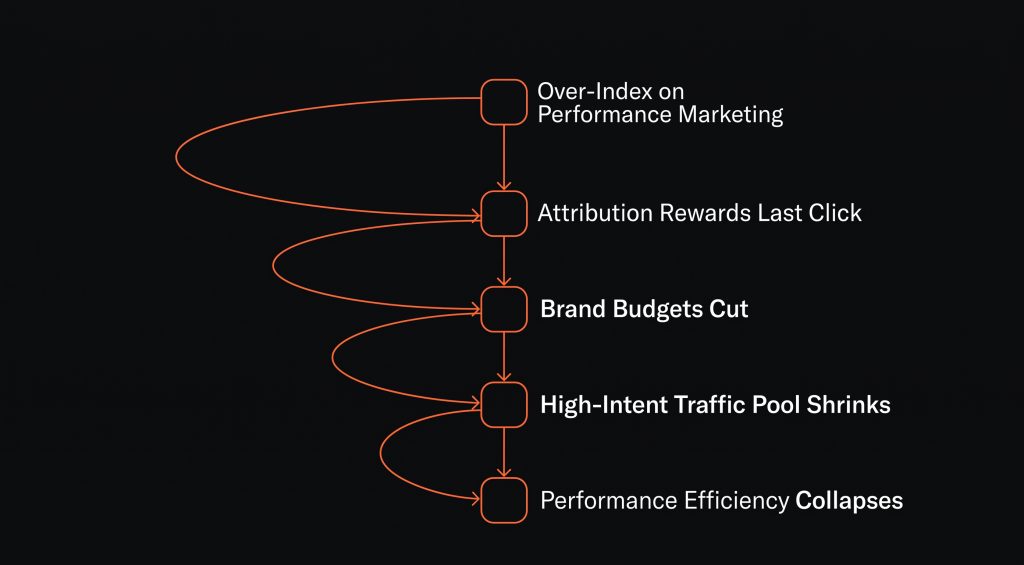
The Doom Loop is a negative spiral in which a company over-invests in short-term performance marketing at the expense of long-term brand building. Attribution rewards the last click, brand budgets get cut, the pool of high-intent traffic dries up, and performance efficiency eventually collapses with it. WARC and Analytic Partners define the pattern in their 2025 report, “The Multiplier Effect: A CMO’s Guide to Brand Building in the Performance Era.”
From the performance marketer’s perspective, every dollar spent should see the right amount of dollars back.
From the brand marketer’s perspective, you lose your brand if you only spend for immediate performance.
Leadership wants tangible results mapped to marketing budgets.
SAVD helps companies avoid the Doom Loop.
Most companies leave brand marketing out of the math. Marketing relies on brand for performance. WARC and Analytic Partners found that over-investing in performance advertising at the expense of brand reduces revenue returns by 20 to 50%. Companies trying to align marketing dollars to profit are slashing budgets and putting themselves out of business.
The problem is how that attempt gets measured.
Shortcomings of Attribution Modeling
Performance marketers love attribution reports. They assign a dollar value to each channel, which makes budget decisions easy. Who would fault you for investing in Channel A when its ROI looks higher than Channel B’s?
But attribution modeling misses the true incremental impact of each channel. It adds color to granular reporting. It does not tell you the truth.
How the Doom Loop Begins
Attribution rewards lower funnel performance channels like paid search, organic search, and direct visits. They get credit as the last touchpoint. The work other channels did to move the user toward purchase doesn’t show up.
A strategy led by attribution alone cuts “non-converting” brand budgets in favor of “converting” lower-funnel channels. Slowly, the pool of high-intent traffic dries up. Without brand equity, no incremental users move down the funnel.
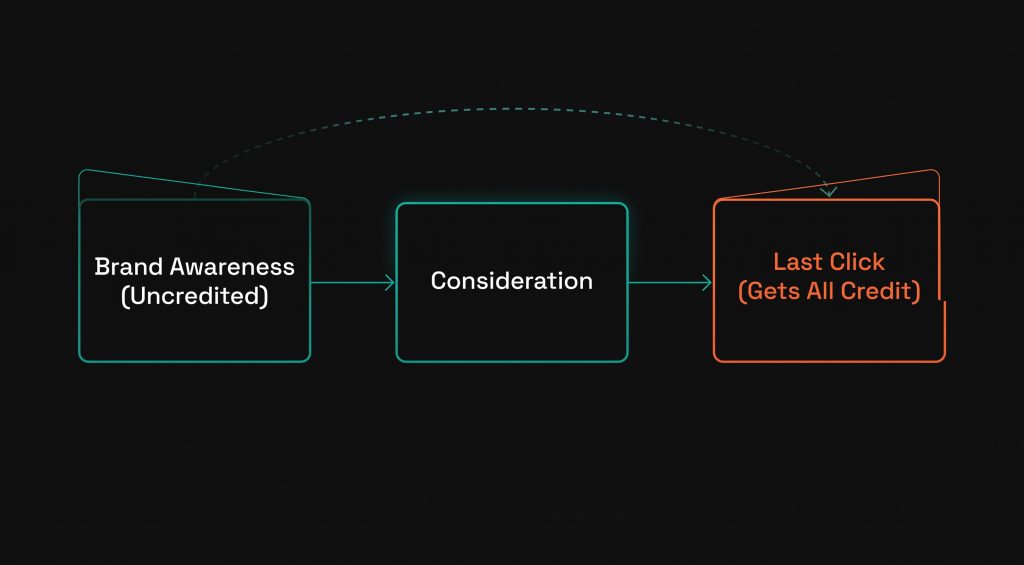
For a marketing leader, the key challenge now becomes: “How should the media be valued to avoid the doom loop, while continuing to understand how our dollars are performing for the business directly?”
That question opens the Growth Loop conversation.
Embrace your Growth Loop
The Growth Loop for your business aligns each marketing team’s goals, metrics and tools in service of the unified business objective.
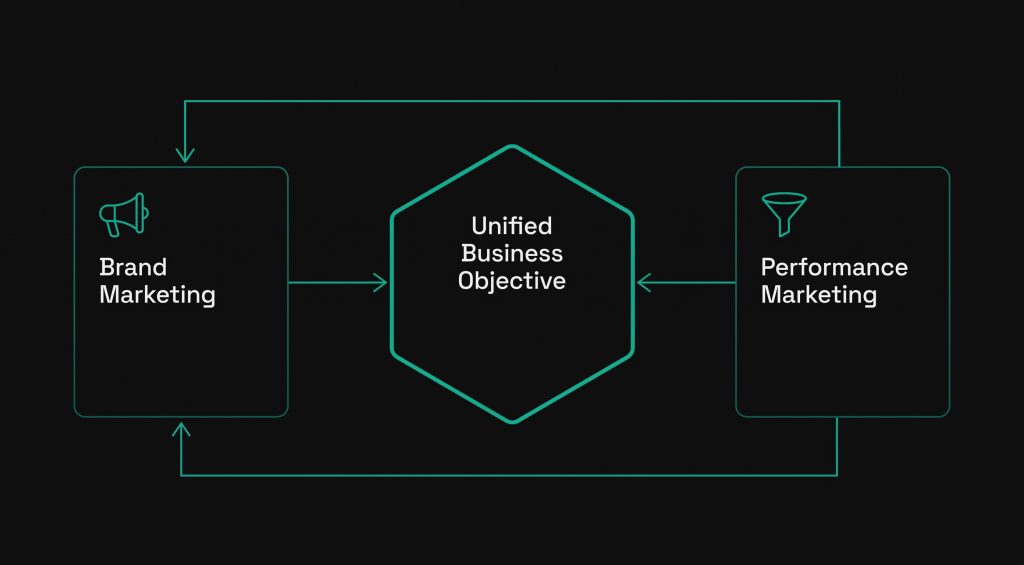
SAVD is here to help you create your own custom Growth Loop, the operating model behind Brandformance, linking strategy to tactics and measurement through the right data visibility. In the meantime, here are some key goals you can begin working towards within your marketing teams:
- Marketing team goals should encourage an atmosphere of teamwork. The KPIs of the brand marketing team should feed quality traffic to the performance marketing team, creating one shared narrative on performance.
- Don’t rob one marketing team to feed another marketing team. Once there is a marriage of KPIs from the brand marketing team to the performance marketing team, the money should flow together too. Base brand and performance budgets on the value each adds to the business. Use verifiable metrics these channels can optimize within the budgeting timeframe.
- Don’t just use media mix models or attribution models alone to direct your marketing mix. Context matters. Results of one media type rely on the results of another. Use these as directional indicators, not as the budget decision itself.
Works Cited: WARC and Analytic Partners. The Multiplier Effect: A CMO’s Guide to Brand Building in the Performance Era. 2025. Further reading: Price, Kate. The Multiplier Effect: How Brands Unleash Full-Funnel Growth. Prophet. Link.
Frequently Asked Questions
What is the Doom Loop?
The Doom Loop is a negative spiral in which a company over-invests in short-term performance marketing at the expense of long-term brand building. Attribution rewards the last click, brand budgets get cut, the pool of high-intent traffic dries up, and performance efficiency eventually collapses with it.
How much can over-indexing on performance marketing cost a business?
WARC and Analytic Partners found that over-investing in performance advertising at the expense of brand reduces revenue returns by 20 to 50%, a pattern documented in their 2025 report, The Multiplier Effect: A CMO’s Guide to Brand Building in the Performance Era.
Why can’t attribution modeling alone guide a marketing budget?
Attribution modeling assigns a dollar value to each channel, which makes budget decisions look easy, but it misses each channel’s true incremental impact. It adds color to granular reporting without telling the truth about what actually drove the outcome.
What is the Growth Loop?
The Growth Loop aligns each marketing team’s goals, metrics, and tools in service of one unified business objective, replacing the siloed strategies that let brand and performance teams each claim success against a different yardstick.
How should a business balance brand and performance budgets?
Base brand and performance budgets on the value each channel adds to the business, using verifiable metrics within the budgeting timeframe, rather than robbing one marketing team to fund another or relying on media mix models or attribution models alone to set the split.
About SAVD
SAVD BY AI is a system-level consultancy for AI-driven marketing organizations. We help enterprise teams align brand and performance budgets around one Growth Loop instead of a last-click model that starves brand. This is Brandformance in practice.
For operators rethinking how brand and performance get measured together, we welcome the conversation.
Next in the SAVD by Series: how routing intelligence coordinates decisions across the enterprise.
Dipak Kamdar is a Partner at SAVD BY AI, a system-level consultancy for AI-driven marketing organizations. SAVD pairs product leads who worked on some of Google’s largest lead-generation advertisers, working closely with the engineers behind its Bidding, AI Max, and Performance Max systems, with PhD data scientists with deep marketing-science expertise.