SAVD by ‘A New Age of Growth Marketing’
Part of the “SAVD by” Series
By Dipak Kamdar, Partner at SAVD
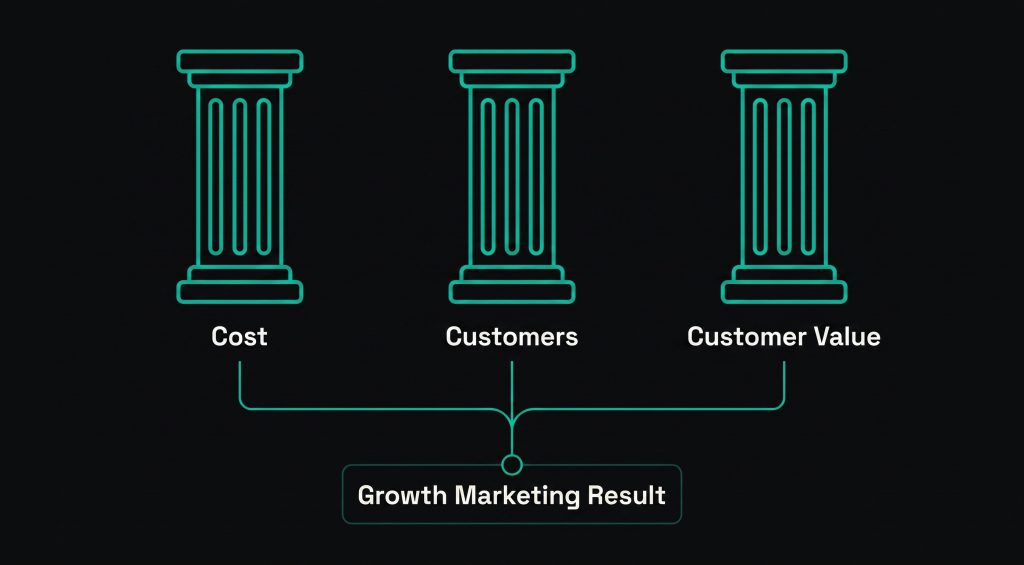
The three pillars of growth marketing are cost, customers, and customer value: what you spend on media, the rate at which media turns into customers, and the value those customers return to the business. Every optimization decision in a growth organization traces back to one of these three.
The goal of growth marketing has not changed. The path is always moving, but the goal remains: Grow the Business.
The path from marketing dollars to business growth feels more winding than before. Change always makes it feel that way. But capabilities now exist that actually make the path from marketing to business growth more direct than we could ever previously imagine.
What Are the Three Pillars of Growth Marketing?
The three pillars of growth marketing are cost, customers, and customer value: what you spend on media, the rate at which media turns into customers, and the value those customers return to the business. Every optimization decision in a growth organization traces back to one of these three growth marketing pillars.
A lot has been written on what AI changes about the growth marketing landscape. In this environment it’s tough to know what to adopt and what not to adopt. But it’s important to keep your eyes on the goal as you make your decisions.
The goal of business growth has not changed and neither have the three contributing factors of growth marketing:
- Cost. Optimizing your media to spend the right amount to maximize your return.
- Customers. Optimizing to improve the rate at which your media turns into a customer.
- Customer value. Optimizing to improve the value you bring to those customers and the value those customers bring to your business.
All Marketing is Performance Marketing Now
With each of the three pillars there are two questions: how do you define and how do you improve?
How Do You Define?
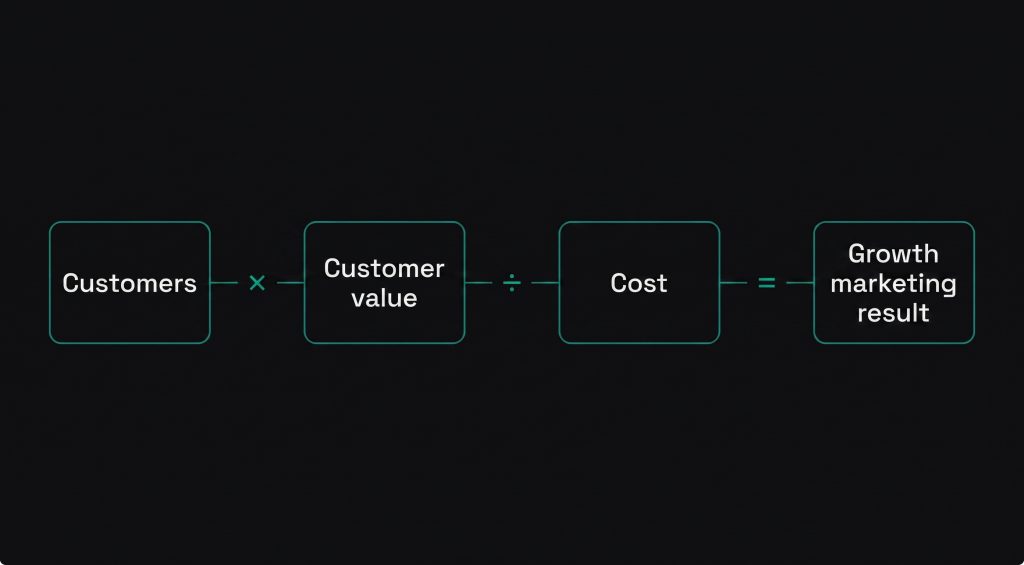
Performance marketers have always loved the formula:
Growth Marketing Result = [Customers * Customer Value] / Cost.
And brand marketers have always rolled their eyes at the formula, a fight that goes back decades. The formula is the right way to view marketing results. But, what is (and has always been) arguable are the definitions within the formula:
- How do we credit our media with getting a customer?
- How do we define an official customer?
- How do we value that customer at the point we label them a customer?
Coordination within your organization and data alignment produce these answers. SAVD sets the stage to get these definitions right.
Getting the definition right matters more than getting the tactics right. We go deeper on that idea in how a wrong goal misdirects everything a marketing program builds on top of it, using Don Norman’s design framework to show why cost per lead and ROAS were never the actual goal.
How Do You Improve?
Ad optimization. Spend optimization. User experience optimization. These have always been ways marketers have improved their growth marketing performance. These ways still exist, and AI resources are here to help with these ways of improving performance.
Google’s own documentation on value-based Smart Bidding makes the customer-value pillar concrete: the bidder needs two or more differentiated conversion values before it can optimize toward anything real. Feed it one flat number and it optimizes toward that flat number, not toward the customers actually worth having.
But cross-functional decisions are the key to differentiating your ways of optimizing. And that’s where SAVD is here to help.
Growth marketing now involves everyone in the business, and this can feel overwhelming, making the path to growth feel more “winding” and less direct. Growth marketing now involves questions like:
- At what point in the process do we charge customers for the first time?
- What does our pricing structure look like and why?
- How do we properly value a customer?
- What is the biggest lever to drive customer value?
- What offerings would match our potential customer base that we don’t currently offer?
- Do we need to change the user experience?
- Do we need to change how we route a potential customer?
A lot of the decisions to these questions have not historically sat with the marketing team, nor should they sit solely with the marketing team today. Optimization is a moving flywheel that involves collaborative decisions across the business, not a siloed call.
Growth marketing approaches can open the door for new structures within the business. Everyone needs to be in communication. Silos can no longer exist. SAVD sets the stage for these cross-functional “How Do You Improve?” conversations.
The three growth marketing pillars, cost, customers, and customer value, are intertwined. Your organization should be too.
The SAVD by Series
SAVD wants to help you get this right too. In the coming weeks we’ll be posting a series. One topic for each pillar, though we could roll out a list on each topic.
Keep an eye out as we bring you content on:
- how brand and performance get measured against one Growth Loop: Avoiding what we call “The Doom Loop” of performance marketing.
- routing intelligence, the missing layer in high-velocity growth stacks: The best ways to get your audience to the right place at the right time. Specifically in this new “less clicks” world we’re living in.
- telling your angels from your devils in customer evaluation. The ‘importance of getting’ and ‘how to get’ the right methodology in place for your business in valuing customers.
Frequently Asked Questions
What are the three pillars of growth marketing?
The three pillars of growth marketing are cost, customers, and customer value: what you spend on media, the rate at which media turns into customers, and the value those customers return to the business. Every optimization decision in a growth organization traces back to one of these three.
What is the growth marketing result formula?
Growth Marketing Result equals Customers multiplied by Customer Value, divided by Cost. The formula itself isn’t contested; what’s always been arguable are the definitions inside it, like how media gets credited, how a customer is officially defined, and how that customer is valued.
Why can’t the marketing team alone answer these growth questions?
Growth marketing now touches pricing structure, customer valuation, product offerings, user experience, and routing decisions. These decisions have not historically sat with the marketing team alone, and shouldn’t today either, since optimization is a collaborative flywheel across the business, not a siloed call.
What produces the right definitions for cost, customers, and customer value?
Coordination within an organization and data alignment produce the right answers to how media gets credited, how a customer is defined, and how that customer is valued at the point they become one.
About SAVD
SAVD BY AI is a system-level consultancy for AI-driven marketing organizations. We help enterprise teams align cost, customer, and customer-value decisions across marketing, product, and sales into one coordinated growth system.
For operators coordinating growth decisions across teams, we welcome the conversation.
Dipak Kamdar is a Partner at SAVD BY AI, a system-level consultancy for AI-driven marketing organizations. SAVD pairs product leads who worked on some of Google’s largest lead-generation advertisers, working closely with the engineers behind its Bidding, AI Max, and Performance Max systems, with PhD data scientists with deep marketing-science expertise.