SAVD by Customer Evaluation: Telling Your Angels From Your Devils
Part of the “SAVD by” Series
By Dipak Kamdar, Partner at SAVD
Customer evaluation is the practice of scoring prospective and existing customers by their predicted long-term value to the business, instead of treating every conversion as equally valuable, so acquisition, retention, and bidding decisions get made against what a customer is actually worth.
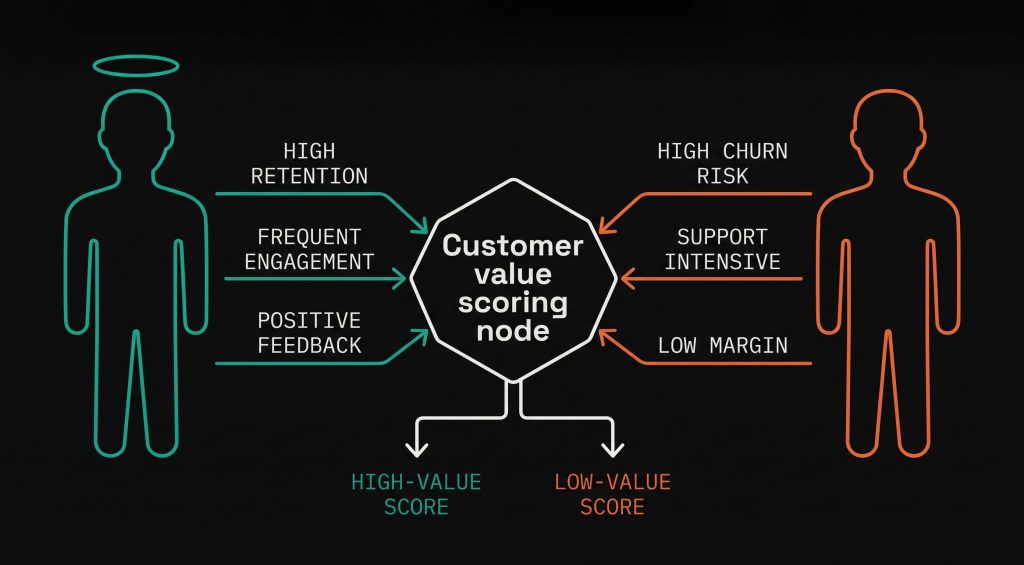
On November 8, 2004, The Wall Street Journal ran a story about Best Buy that should still make performance marketers uncomfortable.
Best Buy’s CEO, Brad Anderson, wanted to separate the “angels” among his customers from the “devils.” Angels bought high-definition TVs, portable electronics, and new releases without waiting for markdowns. Devils bought loss-leader merchandise and flipped it on eBay, gamed the rebate system by returning purchases and rebuying them at open-box discounts, and forced price-match guarantees down to the retailer’s own cost. Working with Columbia professor Larry Selden, Best Buy’s task force found it could tell the two apart, and that a fifth of its customers accounted for the bulk of its profits. Selden’s underlying theory was blunt: at most companies, the losses produced by devil customers wipe out the profits the angels generate.
If you were optimizing strictly for a low Customer Acquisition Cost, a devil looked like a win. Cheap click, fast conversion. It was only on the balance sheet that the truth showed up, and Best Buy had to rebuild its retail and marketing strategy around deterring devils and attracting angels.
When you optimize for aggregate CAC, you might just be buying devils at a discount.
Last time, in Routing Intelligence, we mapped how customer interactions get prioritized and sequenced toward one global economic outcome. That system runs on a persistent customer-state score. Growth marketing comes down to three questions: how we credit our media, how we define and drive customers, and how we calculate the value of those customers. Brandformance covered the first, Routing Intelligence covered the second. Today is the third, and the one the other two quietly depend on: you can’t route toward a value you haven’t scored.
Every time a user searches for something or scrolls their feed, there’s a hidden frenzy of auction activity working to surface the right ad. Marketing is the process of showing the right ad, at the right time, to the right user. Ad, time, user look like equal parts of the same sentence. They aren’t. Knowing who the right user is shapes the other two.
The “in aggregate” problem
Ask a fellow marketer who their ideal customer is, and you’ll get some version of: “We’re looking for [demographic] interested in [intent].” If that were really the ideal user, digital marketing solved this years ago. What your fellow marketer actually means is that users in this demographic and intent bucket, in aggregate, tend to be the most valuable customers. That’s a different claim, and in a world where users have more avenues of influence, more sophisticated needs, and preferences that shift by the week, leaning on “in aggregate” is dangerous. Your competition has already moved past aggregate optimization.
Where the old model breaks
The old playbook: finance takes historical revenue, calculates operating profit, accounts for margin, and hands marketing a single number, Customer Acquisition Cost, passed down to marketing managers as gospel. Every campaign, every channel, every manager held accountable to that one figure.
All the nuance of customer intent, the shifting preference, the compounding value of a customer over time, boiled down to one number.
The problem isn’t that finance wants a target. It’s that CAC alone can’t tell the difference between a customer worth $200 and a customer worth $20,000. Measuring acquisition against a flat cost, instead of against the value a customer actually brings, leaves profit on the table. Shifting from optimizing on CAC to optimizing on ROI is the single change that determines whether the rest of this matters.
Building your value fingerprint
Look closely at the customers who found real value in your offering. Patterns emerge: traits, behaviors, signals that show up again and again. Look at the customers who never resonated, and a different set of patterns shows up there too.
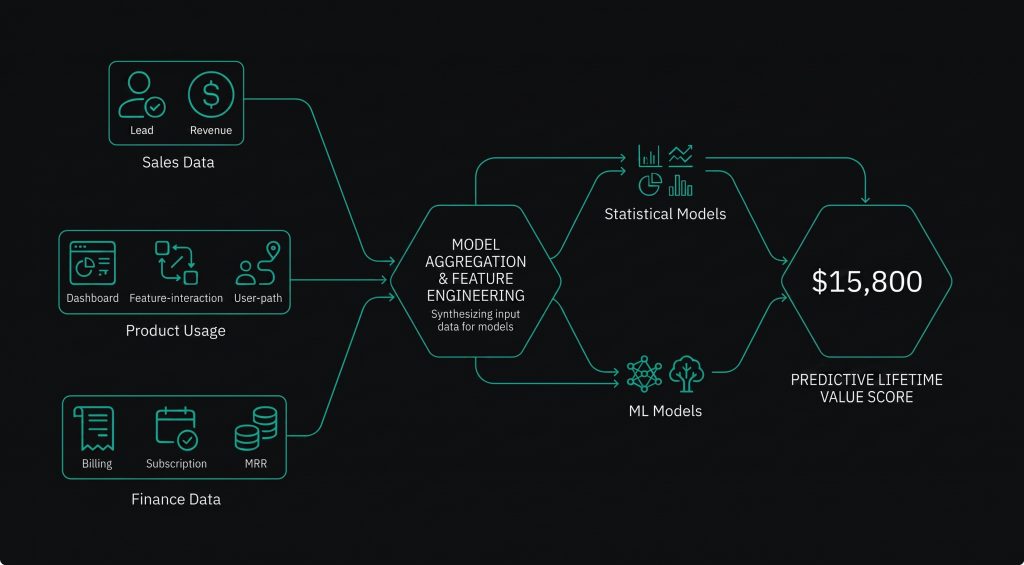
Your fingerprint doesn’t live in one department. Sales holds close rates and deal quality. Product holds usage data, who actually engages after they buy. Finance holds the margins that tell you which of those “converting” customers were angels and which were devils in disguise. Build the fingerprint from marketing data alone, and you’ll only ever see half the picture.
This fingerprint is earned: it comes from rich historical data unique to your business, and it can’t be copied off a shelf. Even a competitor selling the exact same product has a different ideal customer than you do, because their history and their interactions are their own.
What is customer evaluation?
Customer evaluation is the practice of scoring prospective and existing customers by their predicted long-term value to the business, instead of treating every conversion as equally valuable. It replaces a single acquisition-cost target with a value score, so acquisition, retention, and bidding decisions get made against what a customer is actually worth.
But value doesn’t mean the same thing for every business. It depends on how your customers actually pay you, and how long it takes to find out.
The four business archetypes
Cross how a customer pays with how long it takes to know their value, and four archetypes fall out, each one changing what “value” means and how early you can trust a score.
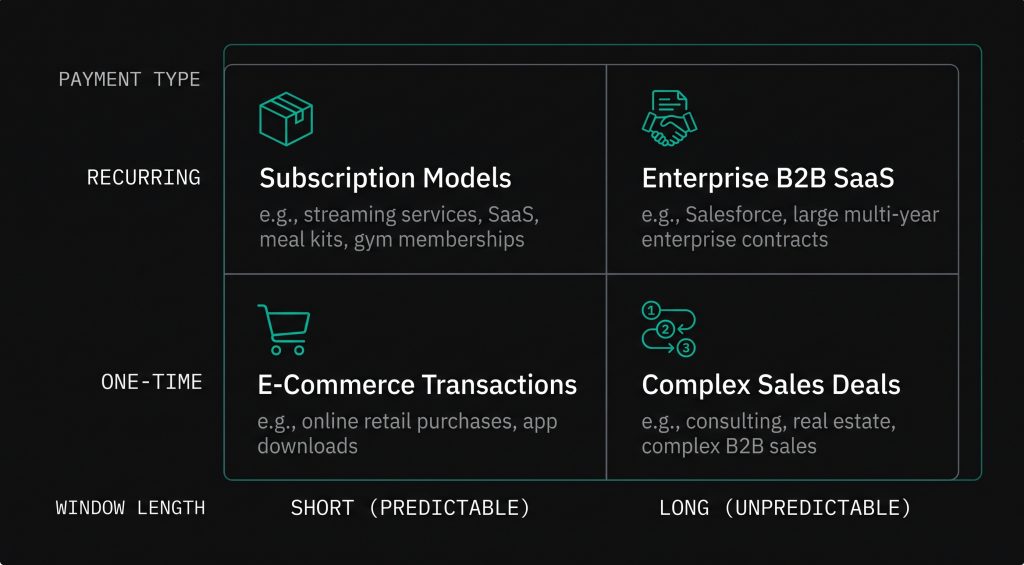
| Payment Type | Short Window (Predictable) | Long Window (Unpredictable) |
|---|---|---|
| One-time | A single-purchase business where the outcome resolves fast: a big-ticket retail purchase, a one-off home-services job. Value is close to fully knowable within the transaction itself. Basket composition, price sensitivity, and channel largely are the value, not a proxy for it. | A single purchase moving through a multi-stage sales cycle: a considered B2B purchase, a large one-time project engagement. Value isn’t known at first contact, so intermediate stage-weighted values (a qualified lead is worth more than a raw one) stand in for eventual deal value until the deal closes. |
| Recurring | A subscription or membership business where early usage tells you almost everything: a DTC subscription box, a SaaS free trial converting within days. Depth of engagement in the first days predicts retention and expansion months out, so the value score can be trusted early. | A relationship that compounds over years and takes a while to prove itself: enterprise contracts, renewal-driven services. Early signals are weaker proxies here, and the model has to weight long-tail retention and expansion, or it will overvalue customers who look good on day one and churn by month six. |
Which quadrant you’re in determines which of the methods in the next section actually applies to you.
What is predictive lifetime value (pLTV)?
Predictive lifetime value (pLTV) is a modeled estimate of a customer’s total future economic contribution to a business, generated from early behavioral and transactional signals captured within the first interactions after acquisition, rather than calculated months later once the actual returns and revenue have already accumulated.
From fingerprint to score
The modern version of the value fingerprint shows up as pLTV. The mechanics are consistent across vendors and approaches: identify the early behavioral dimensions that separate historically high-value customers from the rest (first-purchase composition, session depth, feature adoption, support and satisfaction signals), train a model on clean historical cohort data, and score new customers against it almost immediately after acquisition rather than waiting for the returns and rebates to roll in.
Two broad approaches show up in practice for transaction-based businesses: statistical models like BG/NBD and Gamma-Gamma estimate future spend from transaction patterns alone, while gradient-boosted trees and other ML methods widen the feature set to behavioral and support data and generally win on accuracy at the cost of being harder to explain to a skeptical CFO.
That’s the ecommerce version. Lead-gen growth marketing doesn’t have a transaction log to anchor a model against, so the methods shift with it:
- Propensity score modeling predicts the probability that an anonymous visitor will fill out a lead form at all, based on browsing behavior, referral source, and time on site. This is a pre-lead qualification tool, useful before you have a name to score.
- Lead scoring classification (logistic regression, XGBoost) predicts the likelihood that a captured lead converts into a paying customer, using firmographic and demographic data. This is where most B2B teams live, and it maps directly to the one-time, long-window archetype above.
- Survival analysis (Cox proportional hazards) predicts how long a lead sits in a given pipeline stage before converting or dropping out. Instead of a flat value, it gives you a value that decays the longer a lead sits still, which keeps ad platforms from overbidding on stalled pipeline deals.
Which family fits depends on the same archetype you already placed yourself in. A one-time, short-window business can often get by on the statistical floor. A one-time, long-window business needs lead scoring and survival analysis working together, one to qualify, one to time-weight. A recurring business, short or long window, needs the wider ML feature set to catch retention and expansion signal a transaction log alone won’t show.
Whichever family you’re in, the same constraint shows up eventually: the model that’s most accurate isn’t always the model that’s fast enough to use. We saw this on a client whose profile looked like a two-sided marketplace with a heavy revenue skew across accounts. The first version of the value model only reached useful predictive power at day 30, and it needed a wide feature set (dozens of inputs) to get there. The problem was that the bidder needed a signal by day 7 to act on it at all; a value model that’s accurate a month too late doesn’t help an auction that runs today. We rebuilt it, compressed the feature set down to fewer than four inputs, and hit 82% predictivity within that seven-day window. The lesson: a model tuned for accuracy alone can miss the actual constraint, how fast the signal has to arrive to be useful to the system consuming it.
Value-Based Bidding in practice
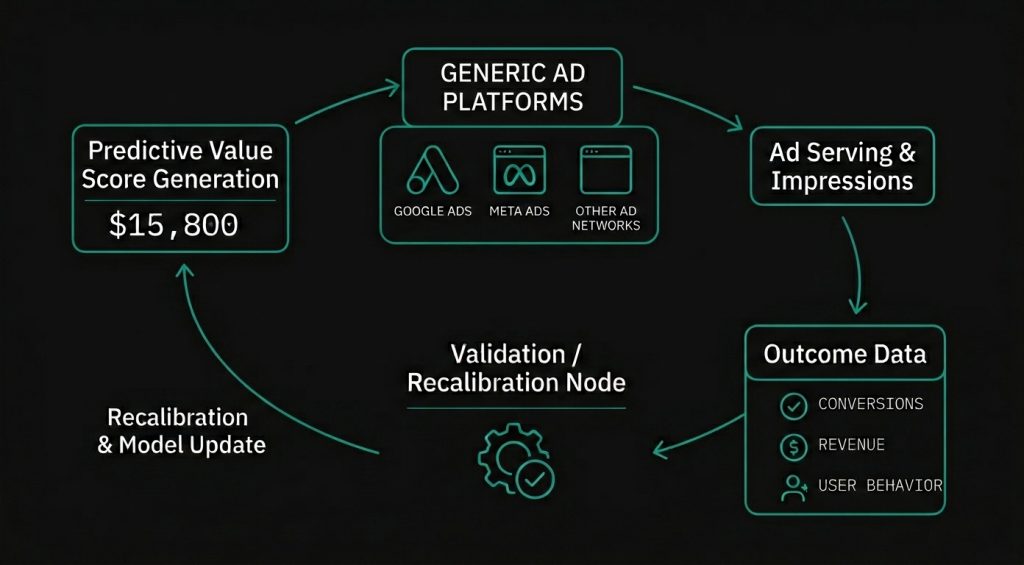
A pLTV score only pays off once it reaches the platforms buying your media. Value-Based Bidding is the mechanism: instead of bidding to a flat cost-per-conversion target, you feed the platform a real value per conversion, and Smart Bidding strategies like Maximize Conversion Value and Target ROAS optimize toward that value directly. Conversion value rules let you adjust those values dynamically by audience, device, or location without retagging anything.
For the long-window archetypes, this means feeding staged or modeled values rather than waiting for the actual close. A raw lead and a sales-qualified lead should never carry the same value in the platform, and current guidance from Google Ads and 2026 practitioner sources both treat this as the difference between an account that learns and one that starves its best signal by averaging it away.
How do you know a value score is right?
A value score is a hypothesis until it’s checked against what customers actually did. The standard practice: train the model on a historical cohort, use it to predict a holdout cohort the model never saw, and compare predicted value against realized value at fixed intervals, commonly 30, 60, and 90 days out. Where the prediction and the actual diverge, that’s the recalibration trigger, not a one-time calibration you set and forget.
This is also where the interpretability trade-off from the last section matters. A model that’s more accurate but harder to explain still has to earn trust with whoever controls the acquisition budget, which means the validation step isn’t optional even when the model is performing.
Where to start
If your business is still treating every customer the same, here’s where the value already sitting in your customer base goes unmeasured, and three concrete steps to close that gap:
- Map your business to one of the four archetypes above, and be honest about how early you can actually trust a value signal. A recurring, long-window business that scores itself like a one-time, short-window one will keep overvaluing customers who look good on day one and churn by month six.
- Inventory the data you already have beyond raw value, across sales, product, and finance. Most businesses have more of this than they realize. It’s scattered across systems nobody thought to connect.
- Get Finance, Marketing, and Analytics aligned on shifting the target from CAC to ROI, and name who owns that shift. This is the step that actually determines whether the first two matter.
We’ve built this exact loop before: a predicted value class feeding straight into the bidder so it stops treating every conversion the same. Our own model is Diagnose, Architect, Operate: build the scoring system inside your team, wire it into the platforms, then hand it over. If your team is closer to step one than step three, that’s the harder problem to solve first, and it’s the one worth a real conversation before the tooling.
Frequently Asked Questions
What is customer evaluation?
Customer evaluation is the practice of scoring prospective and existing customers by their predicted long-term value to the business, instead of treating every conversion as equally valuable, so acquisition, retention, and bidding decisions get made against what a customer is actually worth.
What is predictive lifetime value (pLTV)?
Predictive lifetime value (pLTV) is a modeled estimate of a customer’s total future economic contribution, generated from early behavioral and transactional signals captured within the first interactions after acquisition, rather than calculated months later once the actual returns have accumulated.
How is lead-gen customer valuation different from ecommerce pLTV?
Ecommerce pLTV anchors to a transaction log. Lead-gen valuation has no purchase event to anchor against, so it relies on propensity score modeling, lead scoring classification, and survival analysis instead, matched to how long the sales cycle actually runs.
How often should a value model be recalibrated?
Not on a fixed schedule. Compare predicted value against realized value at fixed intervals, commonly 30, 60, and 90 days out, and treat any divergence between prediction and actual as the recalibration trigger rather than waiting for a scheduled review.
Who owns the models and systems SAVD builds?
The client owns the models, features, pipelines, and decision logic at the end of the engagement, in writing. SAVD’s role is to diagnose, architect, and operate the system inside the client’s team, then transfer it, not to retain it as a black box.
About SAVD
SAVD BY AI is a system-level consultancy for AI-driven marketing organizations. We help enterprise teams build the pLTV scoring and value-based bidding systems that connect customer value to acquisition decisions.
For operators building customer-value scoring into their acquisition stack, we welcome the conversation.
Dipak Kamdar is a Partner at SAVD BY AI, a system-level consultancy for AI-driven marketing organizations. SAVD pairs product leads who worked on some of Google’s largest lead-generation advertisers, working closely with the engineers behind its Bidding, AI Max, and Performance Max systems, with PhD data scientists with deep marketing-science expertise.