Google’s August bidding change makes downstream lead quality harder to ignore
My view: this is the first step toward Google pricing the outcome instead of the click
By Dipak Kamdar, Partner at SAVD
Google’s Smart Bidding August 2026 change made the target you type the number the system aims for, on campaigns limited by budget. A $10 Target CPA that had been delivering a $5 actual CPA should no longer be assumed to keep that cushion. Whether that cost you or saved you depends on something most teams cannot see yet: what a customer is worth after the click.
In September I wrote on LinkedIn that Google’s August 17 change holds budget-limited campaigns to the target you set, and that the gap it closed was margin that used to sit with the advertiser. A month on, I think that was the small part of the story. This piece picks up the thread I opened in the Great Decoupling, the split between search volume and the clicks that leave Google, outside the series that ended with Customer Evaluation.
The simplest explanation for the change is rent. Google found a cushion advertisers were keeping and took it. I think that is half of it. The other half is my hypothesis, labeled as one throughout: Google wants a bidding system that learns from a consistent target, its newer bidding products want your downstream data, and together they point toward Google qualifying demand before the click and, at some point, pricing the outcome. Either explanation makes downstream economics more important. The immediate cost effect is not the same for every advertiser.
I spent close to a decade as a performance specialist in Google’s large customer sales organization, working with lead-generation businesses in insurance, fintech and home services. I now build the measurement side. What follows is how the system behaves from that seat. Google has not said any of it.
Table of Contents
What changed in Google Ads on August 17, 2026?
Beginning August 17, 2026, Google changed how budget-limited campaigns using Target CPA or Target ROAS pursue their targets. Campaigns that had been outperforming those targets may now move closer to them. The rollout completed August 27. Budgets still bind, Google does not raise your spend, and it does not change your targets. The change did not directly apply to campaigns that are not limited by budget.
The short version, for anyone who missed it in September. Before August 17, when a campaign hit its budget ceiling, the system lowered bids to stretch the budget, and in doing so it found cheap conversions. For illustration, a campaign with a $10 Target CPA might have been delivering at $5. If you were budget constrained, those cheap clicks and conversions were, in effect, yours to keep. After August 17 the system aims more consistently for the target you set. Mike Ryan’s read of the early data is that the cheaper clicks budget-limited campaigns used to capture became available to campaigns that were not budget-limited.
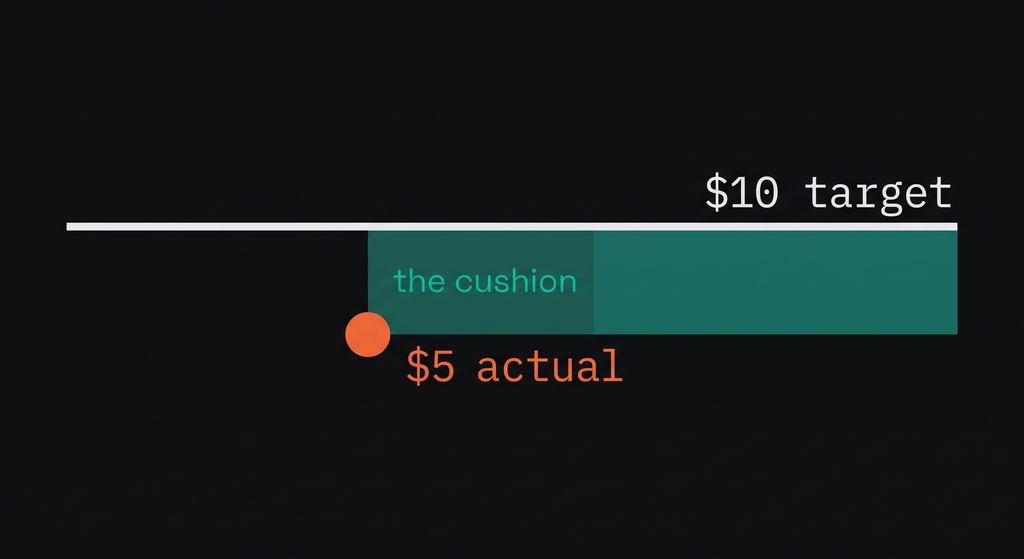
A Target CPA is the number the system optimizes toward. It is not a bid, and it is not a guaranteed price. A $10 target does not mean every conversion now costs $10. It means the system no longer treats $5 as the goal when you told it $10.
Why did capped campaigns pay more per click after the change?
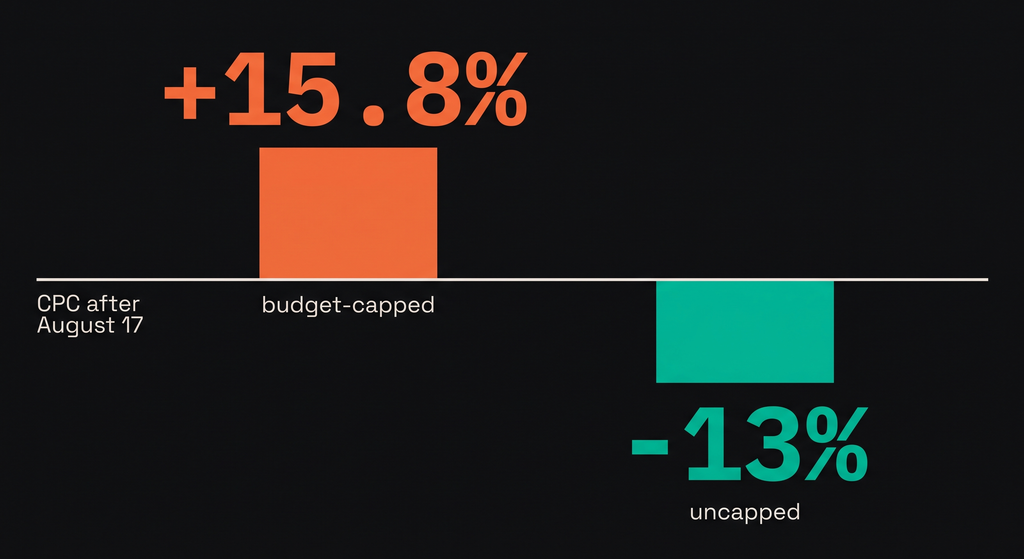
Early retail data shows higher CPCs in budget-limited campaigns. In Smarter Ecommerce’s sample of managed retail Target ROAS campaigns, median cost per click on budget-limited campaigns rose 15.8% after August 17, from €0.38 to €0.44, while campaigns that were never budget-limited fell 13%, to €0.33. Impression share on the capped side fell from 40% to 31%. Before the change, more than half of the budget-limited campaigns in that sample were beating their ROAS targets. That is one sample: retail-heavy, Target ROAS, priced in euros, and a few weeks old.
If realized spend stays flat while CPC rises, the campaign buys fewer clicks. That is the mechanical reason a capped campaign feels the change first.
Two complications, and both matter. The effect was not uniformly inflationary: never-limited campaigns in Smarter Ecommerce’s sample paid less per click, and Ryan puts budget-limited campaigns at roughly 15% to 25% of that population, likely higher among smaller advertisers. And advertisers moved their own targets. In the same accounts, the median Target ROAS on affected campaigns rose 12% the week of the change, and campaigns that were never affected raised their targets 9% anyway. Mike Ryan’s first read, three weeks in, was that the change had moved advertiser behavior more than it had moved prices. Some of what you saw in September was advertisers flinching, and the two effects have not been separated yet.
Alphabet’s blended number will not separate them either. In Q2, the quarter before the change, paid clicks on Google Search and other grew 13% and cost per click grew 3%, per the Form 10-Q. The blend mixes geography, device, surface and vertical.
What I saw in two businesses in September
A lead aggregator, uncapped, was capturing more volume than it had in years, and its carrier partners were paying more for it.
A leading two-sided marketplace, capped, had watched cost per acquisition rise for four weeks with no explanation from its agency.
Those are two conversations, and I am treating them as observation. They are consistent with the split in the retail data: the uncapped aggregator was growing, the capped marketplace was paying more per acquisition. I have not isolated the bidding change from other causes in either business. For the marketplace, the immediate problem was that the team could not tell whether the higher CPA was buying better customers or worse ones.
That is the question I would start with, and most teams cannot yet answer it.
What is journey-aware bidding?
Journey-aware bidding is a Google Ads bidding feature, in beta since May 2026 for Search campaigns on Target CPA, that lets Smart Bidding learn from the full lead-to-sale journey instead of the first conversion event alone. It uses both biddable and non-biddable conversion goals, including calls, forms and later CRM stages, to predict which leads are likely to become sales.
Google announced it at Google Marketing Live on May 7, 2026. It is a separate development from the August change, and the two should not be read as one mechanism.
Why downstream economics matter now
The August change makes the acquisition target you state more consequential. Journey-aware bidding is a separate development that gives Google more downstream signal about lead quality. Together they raise the importance of knowing what you are willing to pay, and which leads justify it.
One possible explanation for the August change is that Google wanted more consistent bidding behavior: a campaign flipping between spending to a budget and spending to a target is harder to learn from. I do not have evidence that the old behavior impaired model learning. What holds either way is that the change forces advertisers to think through the goal they want the system to move toward.
Sending downstream signals to Google can improve bidding. It is not a substitute for keeping your own value model and independent measurement. The work I described in Customer Evaluation, scoring who is an angel and who is a devil before the bid goes in, is the input the August change rewards, and the only version of it you control is the one you build.
The lead-generation industry is the reference point, because it gets hit by this first. Aggregators that model conversion value across carrier partners bid uncapped and calibrated by necessity, because traffic cost is the business, and MediaAlpha said in July that over 80% of P&C ad-spend growth since 2021 has come from two carriers. Carriers, lenders and marketplaces that still run on agent networks or sales teams and lack usable downstream data are the ones this sorts first.
I have watched this once. When value-based bidding took hold from 2021 to 2023, the accounts I worked with that adopted early grew several times over, and the ones that arrived late were bidding against competitors who could see a user value they could not. That is my observation across accounts, and I offer it as that.
What I would check in your account this week
This is a diagnostic. On its own it will not tell you what caused your number to move, and that is the point: most of the explanations people are getting right now are guesses.
- Was the campaign in a “Limited by budget” status before and after the rollout? Compare August 1 to 16 against August 28 onward, and skip the rollout window in between.
- Did targets or conversion definitions change inside the comparison window? A target changed on August 20 is a competing explanation you have to account for.
- CPC, realized spend and conversion rate, by campaign, before and after.
- Matured lead-to-sale rate and contribution margin per click. Platform CPA will not show you this.
- Can downstream sales be reconciled to the acquisition data at all? If they cannot, check four is impossible, and that is the finding.
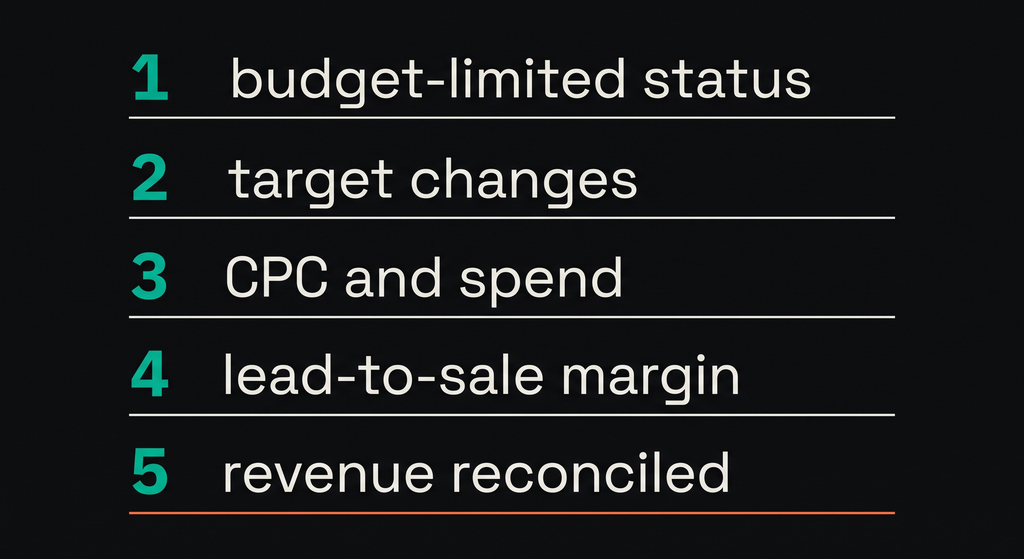
If you can run all five, you can see whether cost and downstream quality moved together, and you still have to separate the rollout from target changes, seasonality and traffic mix before you assign a cause. If you cannot run them, the first problem is measurement. Collect the data, stitch it, and read it as a user journey at the session level so you can see where value leaks between the click and the revenue; that is the routing problem, and it sits after the click, where Google does not run the auction. App plus web, call center plus digital, and consent-constrained journeys are the hardest version of this and the actual work.
While that is being built, the operating rule from my September post still holds: scale the high-intent campaigns with conviction and an honest target, hold low-quality keywords to a tight one, and watch bids weekly while this settles. None of that works on an average. Then improve your conversion rate, because that is the one lever that pays regardless of how Google runs its side. And measure your brand with lift and geo experiments, because branded traffic can look highly efficient and some of it is demand you already created.
SAVD builds the measurement and value-modeling layer that answers those questions across ads, CRM, calls and closed revenue. The work runs Diagnose, Architect, Operate, and it ends with your team owning it.
My hypothesis: qualification moves into AI Mode, and outcome pricing may follow
Everything in this section is my view.
I have seen a version of qualification inside a conversation already, on the other platform. This year we turned on OpenAI traffic for a lead-generation client with a budget that had to be used before month end and no time to set up conversion reporting on the platform side. The client’s own funnel measurement still showed strong post-click conversion, three stages deep. My explanation is that by the time someone clicks out of a long conversation, the model has done the qualification a landing page used to do. The user finishes considering inside the conversation, and the click that reaches the site is further along than a search click. That is one client and one month, so treat it as observation. It is the reason I take the next step seriously.
AI Mode sessions are longer and more conversational. Alphabet said AI Mode queries ran about twice the length of a traditional search in April 2025 and three times by February 2026, with a significant share leading to a follow-up question. That is more intent per session, and plausibly more cost to serve and to match ads into.
Google has not quantified that cost, so take this as inference: a system that knows what each advertiser will pay can scale into that inventory without entering auctions it will lose, and that matters more as the inventory gets more expensive to serve.
Search ad revenue is click-priced. For a higher CPC to stay sustainable for an advertiser, the downstream value has to justify the extra cost. The August change makes the target you state more consequential. Journey-aware bidding is a separate source of information about which leads become valuable customers. Once Google can see your funnel, the step to predicting downstream value before the click is short. I am calling that qualification. It is a probability estimate, and its view of your downstream outcomes depends on the signals you share. Nobody is underwriting anything.
Read the public product sequence in order and I see one line. From Smart Shopping onward the goal, as I read it, was a campaign type comparable to Meta’s: give it a budget, a feed and a target, and let it optimize across all inventory. Performance Max did that across Google’s channels in 2021. Demand Gen carried it into video and feeds in 2023. AI Max, in May 2025, expanded matching and creative inside Search while keeping the campaign structure search advertisers understood.
Journey-aware bidding is Google offering to do the value modeling for you. Direct Offers and native checkout, live in retail with travel partners announced in May, show Google assembling relevance and offers inside the answer. Whether that becomes lead-quality qualification in services is the hypothesis. The record stops at retail and travel.
Google has billed on outcome before, in one place. Pay-for-conversions on the Display Network charges eligible advertisers only when a tracked conversion occurs, with conditions attached: more than 100 conversions in the prior 30 days, 90% of them occurring less than seven days after the click, and a Target CPA under $200. It is Display only, and Google’s own migration guidance drops it when Display campaigns move into Demand Gen. So the precedent is real and narrow. Google has run conversion-contingent billing where measurement is dense, fast and auditable. Whether that reaches Search is unproven, and the Display conditions tell you what would have to be true first: short lags, reliable attribution, and a conversion definition both sides accept.
I can see a future where agents pay per outcome. The product announcements point that way without saying it, and OpenAI’s October 5 move was a new ad format plus conversion measurement; checkout stayed where it was. Users will not hand their buying to an agent all at once, and trust is category-specific. Google likely holds the advantage in discovery and delegated research, where habit carries, and banks, insurers and retailers keep it where identity, regulated advice or the final transaction is involved. Either way, the work that prepares you for that world is the same work that manages rising cost today.
My hypothesis, stated so it can be graded: some higher CPCs will be justified by better downstream conversion quality. The test is whether lead-to-sale rate and contribution margin per click improve enough to offset the higher acquisition cost, read by campaign type and cap status.
What would support or weaken this
Five signals, ordered by how soon you can observe them.
- Journey-aware bidding leaves beta and expands beyond Target CPA on Search.
- Published evidence that imported CRM data changes auction outcomes: lead-to-sale quality, and not only conversion volume.
- Recurring independent measurement of commercial coverage in AI Mode, same methodology period over period. Google does not publish an ad-load figure for AI Mode and I do not expect one. A single snapshot proves nothing. A series would.
- Direct Offers and native checkout moving past retail and travel into services.
- A conversion-contingent payment model in Demand Gen, Performance Max, AI Max or Search. This is the strongest confirmation and the least likely, since Google’s current migration guidance removes the one it has.
Alphabet reports Q3 on October 28 and Q4 in early February. Both give market context and nothing more, because the blended metrics mix geography, device, surface and vertical and cannot isolate this change. The cleaner grade is campaign-level, segmented by budget limitation, target changes and matured conversions: Smarter Ecommerce’s follow-up on the capped-versus-uncapped gap once conversion data has matured, which Mike Ryan has said is coming.
Frequently Asked Questions
What changed in Google Ads on August 17, 2026?
Google changed how budget-limited campaigns using Target CPA or Target ROAS pursue their targets. Campaigns that had been outperforming their targets may now move closer to them. The rollout completed August 27. Budgets still bind, spend is not raised, targets are not changed, and campaigns that are not limited by budget are not affected.
Why did budget-limited campaigns pay more per click after the change?
Before August 17, Google lowered bids on budget-limited campaigns to stretch the budget, which picked up cheap conversions below target. After the change the system aims more consistently for the stated target. In Smarter Ecommerce’s retail Target ROAS sample, median CPC on budget-limited campaigns rose 15.8% while never-limited campaigns fell 13%.
Does the change affect campaigns that are not limited by budget?
Not directly. Google’s documentation scopes the change to campaigns in a Limited by budget status on target-based bid strategies. Mike Ryan’s read of the early data is that cheaper clicks capped campaigns used to capture became available to uncapped campaigns, which is why never-limited campaigns paid less in his sample.
What is journey-aware bidding?
Journey-aware bidding is a Google Ads feature, in beta since May 2026 for Search campaigns on Target CPA, that lets Smart Bidding learn from the full lead-to-sale journey, including calls, forms and later CRM stages, rather than the first conversion event alone.
Is Google moving to charging per conversion on Search?
Unproven. Google has run conversion-contingent billing only on the Display Network, under strict eligibility conditions, and its migration guidance drops that option when Display campaigns move to Demand Gen. Outcome pricing on Search is the author’s labeled hypothesis, with five observable signals listed in the article.
How do I tell whether higher CPCs are buying better customers?
Reconcile closed sales back to the acquisition data, then read matured lead-to-sale rate and contribution margin per click alongside CPC, by campaign type and budget-cap status. Platform CPA alone cannot answer it.
About SAVD
SAVD BY AI is a system-level consultancy for AI-driven marketing organizations. We build the measurement and value-modeling layer that connects ads, CRM, calls and closed revenue, so acquisition teams can see what a customer is worth before the auction does, and then we transfer that capability to the client team. The work runs Diagnose, Architect, Operate.
Related Reading
the Great Decoupling: why search clicks are leaving lead generation
scoring angels and devils in customer evaluation
how routing intelligence coordinates customer decisions
how attribution starves brand budgets in the Doom Loop
Stay connected: follow SAVD on LinkedIn for ongoing analysis of structural shifts in performance marketing and lead generation.
Dipak Kamdar is a Partner at SAVD BY AI, a system-level consultancy for AI-driven marketing organizations. He spent close to a decade at Google as a performance specialist in the large customer sales organization, where three of the 20 largest US advertisers were his clients and his work ran across insurance, fintech and home services lead generation. At SAVD he supports two advertisers each spending over $100 million a year on search, combining that operating experience with data engineering and marketing science to build measurement and value-modeling systems the client team ends up owning.
Sources
- Google Ads Help, “Changes to target based bid strategies” (support.google.com/google-ads/answer/17061251) and “Frequently asked questions about changes to Target-based bid strategies” (answer/17125145); the FAQ states the global rollout completed August 27, 2026.
- Smarter Ecommerce (Mike Ryan), “Google ends its bid suppression era: What it means for your ROAS,” September 17, 2026. Median CPC data first posted on X on September 14 and covered by Search Engine Roundtable on September 15. Sample is managed retail Target ROAS campaigns, priced in euros.
- Smarter Ecommerce, Growing Ecommerce podcast episode 52, “Everyone Raised Their tROAS 12%,” released September 8, 2026: median tROAS up 12% in affected campaigns the week of the change, up 9% in never-limited campaigns, budget-limited share of campaigns 15% to 25%.
- Alphabet Inc., Form 10-Q for the quarter ended June 30, 2026, Google Search & other monetization metrics: paid clicks +13%, cost-per-click +3%.
- Alphabet Investor Relations, “Alphabet Announces Date of Third Quarter 2026 Financial Results Conference Call,” October 6, 2026: Wednesday, October 28, 2026.
- Alphabet Q1 2025 earnings call, April 24, 2025 (AI Mode queries about twice as long) and Q4 2025 earnings call, February 4, 2026 (three times longer; significant share with follow-up questions).
- Google, “Bidding and budgeting at Google Marketing Live 2026,” May 7, 2026: journey-aware bidding announced as a beta for Search Target CPA campaigns.
- Performance Max, December 2021; Demand Gen, September 2023; AI Max for Search announced May 6, 2025.
- Google, January 11, 2026 (Direct Offers pilot in AI Mode) and Google Marketing Live, May 20, 2026 (travel expansion with Booking and Expedia; native checkout for UCP merchants).
- Google Ads Help, “Pay for conversions” (support.google.com/google-ads/answer/7528254), Display Network only, with eligibility conditions; Display-to-Demand Gen migration guidance (answer/17051545).
- OpenAI, “New ChatGPT ads format and measurement,” October 5, 2026.
- MediaAlpha Q2 2026 earnings call prepared remarks, July 29, 2026.